
Chronic sinusitis can cause persistent nasal blockage, facial pressure, post-nasal drip, reduced sense of smell and recurrent sinus infections, often affecting sleep and daily life.
While many patients improve with medicines, some continue to have symptoms because of narrowing or blockage of the natural sinus drainage pathways. For appropriately selected patients, balloon sinuplasty, also called balloon sinus dilation, can be a minimally invasive treatment option.
At Chikitsa Clinic, Guwahati, balloon sinuplasty is offered after detailed assessment with symptoms, nasal examination, nasal endoscopy and CT scan of the paranasal sinuses. Our ENT specialist Dr. Avinava Ghosh is the first surgeon to successfully perform balloon sinuplasty in Northeast India is an invited faculty for balloon sinus dilation at various ENT conferences and academic programmes.
What Is Balloon Sinuplasty?
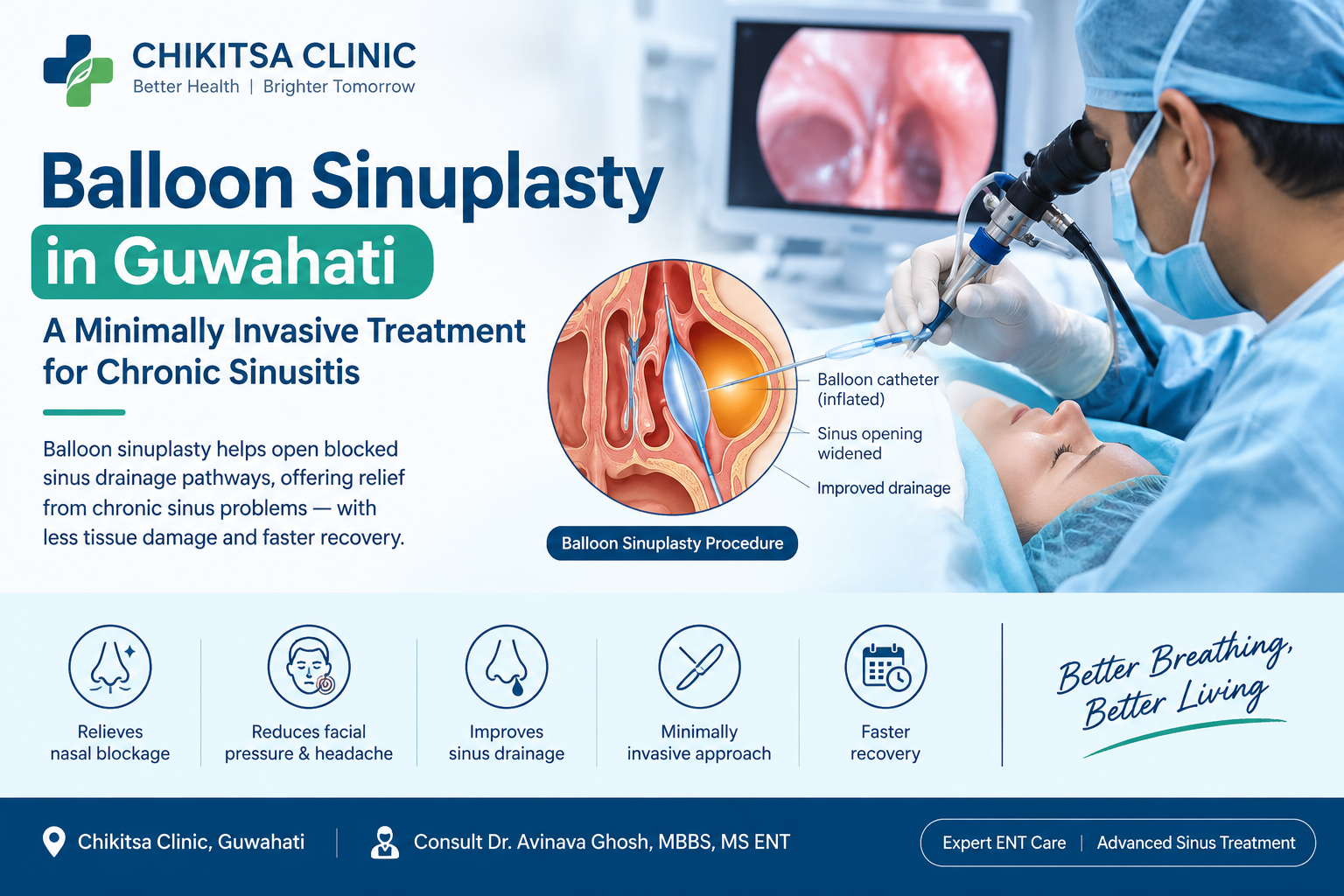
Balloon sinuplasty is an endoscopic, minimally invasive sinus procedure that widens a narrowed sinus drainage pathway.
A small balloon catheter is guided through the nose and positioned at the affected sinus opening. The balloon is gently inflated to widen the pathway and is then removed. Unlike conventional sinus surgery, balloon dilation primarily focuses on opening the drainage pathway while preserving much of the surrounding mucosa and anatomy.
Which Sinuses Can Be Treated?
Depending on the anatomy and nature of the disease, balloon sinus dilation may be considered for:
· Maxillary sinus
· Frontal sinus
· Sphenoid sinus
Careful CT and endoscopic evaluation are important because not every type of sinus disease is suitable for balloon treatment.
Who May Benefit From Balloon Sinuplasty?
Balloon sinuplasty may be considered for selected patients with:
· Chronic or recurrent sinusitis
· Recurrent acute sinus infections
· Narrowed or obstructed sinus drainage pathways
· Selected frontal, maxillary or sphenoid sinus disease
· Chronic rhinosinusitis without extensive nasal polyposis
· Persistent symptoms despite appropriate medical treatment
It is not a treatment for every form of sinusitis. Patients with extensive polyps, fungal sinus disease, extensive inflammatory disease, significant bony changes or substantial obstructing tissue may require Functional Endoscopic Sinus Surgery (FESS) or another surgical approach.
Balloon Sinuplasty vs FESS
Balloon sinuplasty and FESS are different surgical techniques, and neither is automatically better for every patient.
Balloon sinuplasty primarily widens an appropriate sinus drainage pathway, whereas FESS allows the surgeon to remove diseased or obstructing tissue when necessary.
In some patients, balloon dilation may be sufficient. In others, FESS may be more appropriate. Balloon sinuplasty can also be combined with FESS when required. The choice should be based on the patient's disease rather than simply choosing the newer or less invasive procedure.
What Evaluation Is Needed?
Before considering balloon sinuplasty in Guwahati, an ENT specialist should assess:
Symptoms + medical history + nasal examination + nasal endoscopy + CT scan of the paranasal sinuses.
This helps determine the cause and extent of sinus disease and whether balloon sinus dilation is appropriate.
Benefits of Balloon Sinuplasty
For appropriately selected patients, potential advantages include:
· Minimally invasive approach
· No external facial incision
· Focused treatment of the sinus drainage pathway
· Preservation of much of the surrounding tissue
· Ability to combine balloon dilation with FESS when required
However, balloon sinuplasty does not guarantee that sinusitis will never return. Long-term results can depend on underlying inflammation, allergies, nasal anatomy and other individual factors.
Balloon Sinuplasty in Guwahati, Assam
If you are looking for balloon sinuplasty in Guwahati, balloon sinus dilation in Assam, chronic sinusitis treatment in Guwahati, or minimally invasive sinus surgery in Northeast India, specialist evaluation is the appropriate first step.
Dr Avinava Ghosh at Chikitsa Clinic, Guwahati provides balloon sinuplasty for appropriately selected patients after clinical, endoscopic and radiological assessment. Patients from Guwahati, Assam and across Northeast India can be evaluated for this specialised sinus treatment.
Frequently Asked Questions
Is balloon sinuplasty painful?
Balloon sinuplasty is designed to be minimally invasive. The level of discomfort depends on the individual patient and the extent of the procedure.
Do I need a CT scan before balloon sinuplasty?
Yes. A CT scan of the paranasal sinuses is an important part of evaluating sinus anatomy and determining whether balloon dilation is suitable.
Can balloon sinuplasty treat frontal sinusitis?
Yes, in appropriately selected patients. Frontal sinus anatomy can be complex, making CT and endoscopic assessment particularly important.
Can balloon sinuplasty treat sphenoid sinusitis?
It can be considered in selected cases, with appropriate imaging and careful surgical planning.
Can balloon sinuplasty be combined with FESS?
Yes. Balloon dilation and FESS can be combined when different aspects of the sinus disease need to be addressed.
Does balloon sinuplasty involve cutting?
Balloon dilation primarily works by widening the sinus drainage pathway rather than removing large amounts of tissue. Additional endoscopic surgery may be necessary in some patients.
How do I know if I am a candidate for balloon sinuplasty?
The decision requires an ENT evaluation based on your symptoms, previous treatment, examination, nasal endoscopy and CT findings.