
Thyroid disorders are common, and when surgery is required, patients often have concerns not only about the treatment itself but also about the scar that may remain on the neck after conventional thyroid surgery.
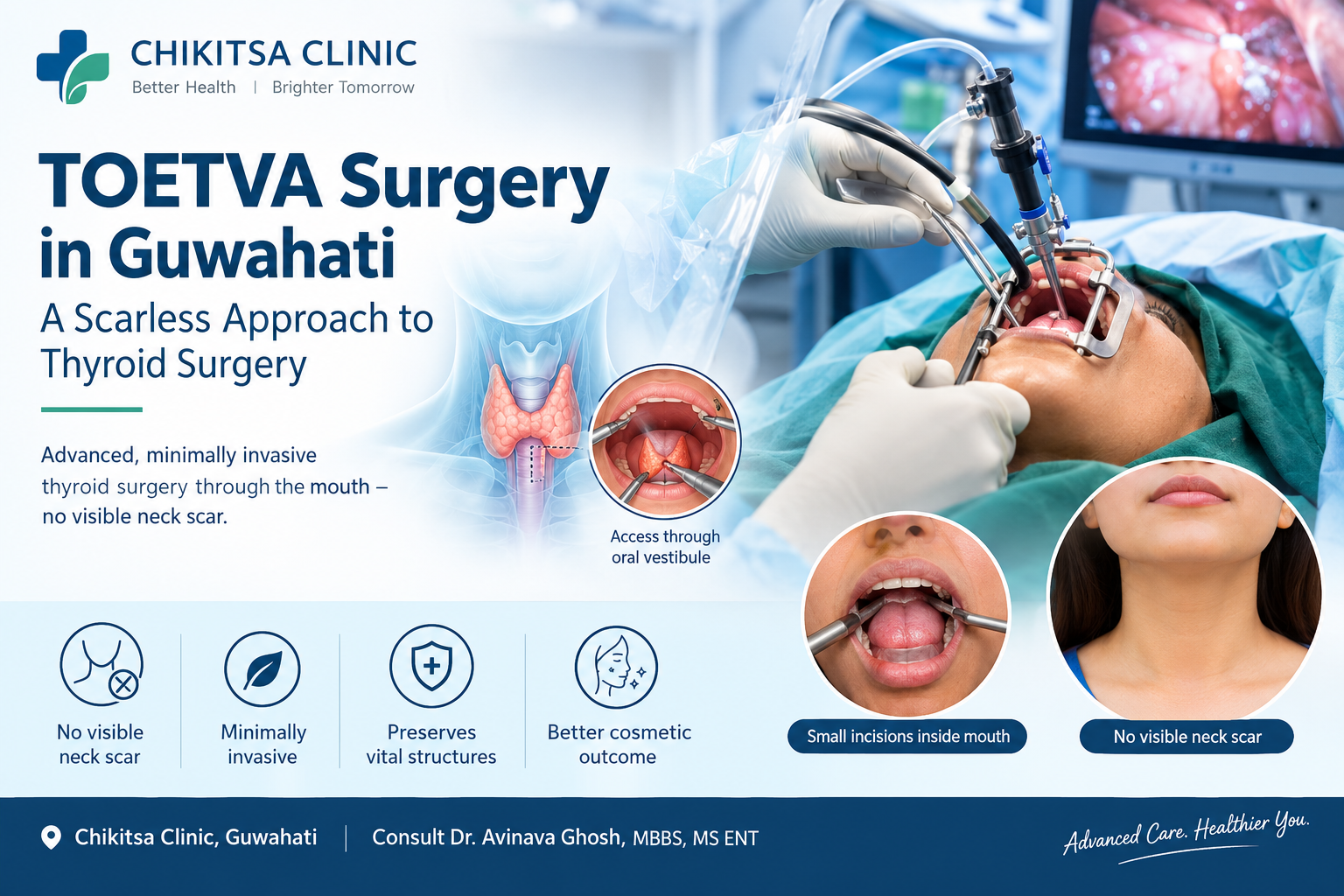
TOETVA (Transoral Endoscopic Thyroidectomy Vestibular Approach) is a minimally invasive thyroid surgery technique designed to access the thyroid gland through small incisions inside the mouth rather than through a conventional incision on the neck. This means that, when appropriate for a patient, the procedure can provide the benefit of no visible external neck scar.
At Chikitsa Clinic, Guwahati, advanced ENT and minimally invasive surgical care can help eligible patients explore modern approaches to thyroid surgery under specialist evaluation.
Medical note: TOETVA is not suitable for every patient. Patient selection depends on the thyroid condition, size and location of the nodule or gland, imaging findings, cancer characteristics when applicable, previous surgery, and overall health.
What Is TOETVA Surgery?
TOETVA stands for Transoral Endoscopic Thyroidectomy Vestibular Approach.
Unlike conventional thyroidectomy, where the surgeon makes an incision in the lower part of the neck, TOETVA uses small access points inside the oral vestibule—the area between the lips and gums.
Through these small openings, specialized instruments and a camera are introduced to reach the thyroid gland. The surgeon performs the thyroid procedure using an endoscopic view of the surgical area.
The major cosmetic advantage is that the surgical access is through the mouth, so there is no conventional visible incision across the neck.
TOETVA has been studied as a minimally invasive alternative to open thyroidectomy in carefully selected patients. Recent evidence continues to show that it can be a feasible approach while offering an important cosmetic advantage, although operative time and patient-selection considerations remain important.
Why Is TOETVA Called a Scarless Thyroid Surgery?
The term “scarless thyroid surgery” is commonly used because TOETVA does not require a visible skin incision on the neck.
In conventional thyroid surgery, an incision is usually made in the lower neck. Although the scar often heals well, some patients may remain concerned about its appearance.
With TOETVA, the access incisions are located inside the mouth. Once the procedure is completed and the tissues heal, there is no typical external neck surgical scar.
However, it is important to understand that “scarless” does not mean that no surgical incisions are made. TOETVA involves carefully planned internal oral incisions.
How Is TOETVA Performed?
TOETVA is performed under general anesthesia by a trained surgical team.
The procedure generally involves:
1. Preoperative evaluation
Before surgery, the patient undergoes a detailed assessment. Depending on the condition, this may include:
Clinical examination
Thyroid function tests
Ultrasound of the thyroid and neck
Fine-needle aspiration cytology (FNAC), when indicated
Additional imaging or investigations when required
Assessment of vocal cord function in appropriate cases
General pre-anesthesia evaluation
The surgeon determines whether TOETVA is appropriate based on the complete clinical picture.
2. Small oral access points
Instead of making an incision on the neck, the surgeon creates small openings in the vestibular area inside the mouth.
3. Endoscopic access
A camera and specialized instruments are introduced through these openings.
The endoscopic camera provides magnified visualization of the surgical field.
4. Thyroid surgery
The surgeon carefully identifies and preserves important structures around the thyroid, including the recurrent laryngeal nerves and parathyroid glands, while removing the planned portion of the thyroid.
5. Closure and recovery
After the operation, the instruments are removed and the oral access points are closed according to the surgical technique.
The patient is then monitored during recovery.
What Are the Benefits of TOETVA?
For appropriately selected patients, TOETVA may offer several potential advantages.
1. No visible neck scar
This is the most well-known advantage of TOETVA.
Because the surgical access is through the oral vestibule, patients can avoid the conventional external neck incision.
This can be particularly important for patients who are concerned about the cosmetic appearance of a neck scar.
2. Minimally invasive approach
TOETVA uses an endoscopic technique with specialized instruments and relatively small access incisions.
3. Direct surgical access to the central neck
The transoral route provides an endoscopic pathway to the thyroid and central neck region.
4. Cosmetic advantage
For suitable candidates, the absence of a visible neck incision can provide a significant cosmetic benefit.
Systematic reviews have reported comparable outcomes for several important surgical parameters between TOETVA and conventional thyroid surgery, while consistently highlighting the cosmetic advantage of avoiding an external neck scar.
Who May Be Suitable for TOETVA?
TOETVA is generally considered for carefully selected patients.
Depending on the individual case, it may be considered for certain patients requiring surgery for:
Selected benign thyroid nodules
Certain thyroid enlargements
Selected early thyroid cancers
Appropriate thyroid lesions where an endoscopic transoral approach is considered technically and oncologically suitable
However, there is no single approach that is best for every thyroid patient.
Recent literature emphasizes the importance of careful selection, appropriate imaging and specialist assessment before expanding TOETVA to more complex cases.
Your ENT or thyroid surgeon may recommend conventional thyroidectomy or another treatment instead if that provides a safer or more appropriate option.
Who May Not Be a Suitable Candidate?
TOETVA may not be appropriate for every patient.
Factors that can influence eligibility include:
Large or complex thyroid disease
Extensive thyroid cancer
Significant involvement of surrounding structures
Certain lymph-node disease patterns
Previous neck or thyroid surgery
Anatomical limitations
Active oral infection or unsuitable oral conditions
Medical conditions that increase surgical risk
Thyroid size or nodule characteristics outside the surgeon's accepted criteria
The exact eligibility criteria can vary depending on the surgeon's experience, available technology and the patient's individual anatomy and diagnosis.
Therefore, patients should not choose TOETVA solely because it is marketed as a “scarless” procedure. The primary goal of thyroid surgery should always be safe and appropriate treatment of the underlying thyroid condition.
Is TOETVA Safe?
TOETVA has been studied extensively as a minimally invasive thyroidectomy technique.
Recent systematic-review evidence involving thousands of patients suggests that TOETVA can be a feasible alternative to open thyroidectomy in appropriately selected patients, with broadly comparable outcomes for several important complications and oncologic measures, while providing a cosmetic benefit.
However, like every surgical procedure, TOETVA has potential risks.
Possible complications may include:
Bleeding
Infection
Temporary or permanent nerve injury
Voice changes
Low calcium levels due to parathyroid dysfunction
Swelling
Seroma
Oral or chin-area sensory changes
Pain or discomfort
Need for conversion to conventional surgery in selected situations
Some studies have also reported that TOETVA may take longer than conventional open thyroidectomy.
Your surgeon should explain the potential benefits and risks before surgery.
TOETVA vs Conventional Thyroid Surgery
The decision between TOETVA and conventional thyroid surgery should be based on the patient's diagnosis, anatomy, surgical requirements and specialist recommendation—not cosmetic preference alone.
Recovery After TOETVA
Recovery varies from patient to patient.
Some patients may experience:
Mild throat discomfort
Temporary swelling
Oral discomfort
Difficulty chewing certain foods initially
Neck tightness or mild discomfort
Temporary numbness around the chin or lower lip in some cases
Your doctor will provide specific instructions regarding diet, medications, wound/oral care and follow-up.
The duration of hospital observation and return to normal activities depends on the procedure performed, the patient's recovery and the surgeon's protocol.
What Should You Ask Your Thyroid Surgeon Before TOETVA?
If you are considering TOETVA, ask your surgeon:
Am I a suitable candidate for TOETVA?
What is the exact diagnosis of my thyroid condition?
Is conventional thyroid surgery a better option in my case?
What are the potential complications?
What are the expected recovery times?
Will I need thyroid hormone replacement after surgery?
What additional tests are required before surgery?
What happens if the procedure needs to be converted to an open operation?
How will my vocal cord and parathyroid function be monitored?
What follow-up will I need after surgery?
A detailed discussion with an experienced ENT/thyroid surgeon can help you make an informed decision.
TOETVA Surgery in Guwahati
Patients searching for TOETVA surgery in Guwahati, scarless thyroid surgery in Guwahati, or minimally invasive thyroid surgery in Guwahati can consult a specialist to determine whether this advanced approach is appropriate for their condition.
At Chikitsa Clinic, Guwahati, patients can seek specialist evaluation for ENT and thyroid-related conditions.
Dr. Avinava Ghosh, MBBS, MS ENT, is associated with ENT care at Chikitsa Clinic. A detailed clinical evaluation is essential before deciding whether TOETVA or another thyroid treatment is appropriate.
Frequently Asked Questions About TOETVA
1. What does TOETVA stand for?
TOETVA stands for Transoral Endoscopic Thyroidectomy Vestibular Approach. It is an endoscopic thyroid surgery technique in which the thyroid is accessed through the oral vestibule rather than through a conventional neck incision.
2. Does TOETVA leave a neck scar?
TOETVA is designed to avoid a visible external neck incision. The surgical access points are located inside the mouth.
3. Is TOETVA completely scarless?
The term “scarless” generally refers to the absence of a visible neck scar. TOETVA still involves small surgical incisions inside the mouth.
4. Is TOETVA suitable for thyroid cancer?
TOETVA may be suitable for selected thyroid cancer patients, particularly certain early and appropriately located cancers. Cancer type, tumor size, lymph-node involvement and other factors must be evaluated before surgery.
5. Is TOETVA better than conventional thyroid surgery?
Not necessarily for everyone. TOETVA offers an important cosmetic advantage, but conventional thyroid surgery may be more appropriate depending on the patient's diagnosis and anatomy.
6. Is TOETVA painful?
Some discomfort can occur after surgery. Pain levels vary between patients and depend on the procedure and individual recovery.
7. How long does TOETVA surgery take?
The operating time varies according to the thyroid condition and complexity of the procedure. Studies have found that TOETVA can take longer than conventional open thyroidectomy in some patient groups.
8. Can everyone with a thyroid nodule undergo TOETVA?
No. TOETVA is a specialized procedure for appropriately selected patients. A thyroid surgeon must evaluate the size, location and nature of the nodule and other clinical factors.
9. What tests are needed before TOETVA?
Depending on the patient, evaluation may include thyroid blood tests, ultrasound, FNAC, imaging and preoperative assessment.
10. Where can I consult for thyroid surgery in Guwahati?
You can consult an ENT/thyroid specialist at Chikitsa Clinic, Guwahati, for evaluation and discussion of suitable surgical options.
Final Takeaway
TOETVA is an advanced minimally invasive approach to thyroid surgery that accesses the thyroid through the mouth and avoids a visible neck incision. For carefully selected patients, it can provide an attractive cosmetic alternative to conventional thyroid surgery.
However, the absence of a neck scar should not be the only reason to choose this technique. Correct diagnosis, patient safety, surgical expertise and appropriate patient selection are the most important considerations.
If you have a thyroid nodule, thyroid enlargement, suspicious thyroid lesion or have been advised to undergo thyroid surgery, consult an experienced specialist to understand which surgical approach is safest and most appropriate for you.
For thyroid and ENT consultation in Guwahati, consult Dr. Avinava Ghosh at Chikitsa Clinic.